
What Venus IT taught me about building together, the power of being seen and what makes a community real.
In 2011, I had almost finished my degree in Computer Science at the Universidad de las Ciencias Informáticas (UCI, University of Information Sciences) in Havana, Cuba. The university combined academic study with software-development contracts, giving selected students the chance to work on real projects.
On the project I joined, every programmer was a man and every analyst and QA was a woman. Nobody had written this rule down. I wanted to be a programmer, I loved writing code. I had spent nights in the lab learning as much as possible and had participated in hackathons and programming competitions. But when I asked for a programming role, I was told no and assigned to work as an analyst. No reason was given, no test I could take, no other option. I wanted to build and interact with the code. The choice had been made for me.
I have learned since then that the visible structure of a system is rarely its full structure. The university’s language was that anyone from any background could enter if they passed the admission exams, and any student could, in principle, hold any role. The system operating in practice assigned technical roles by gender. Venus IT became our attempt to bridge the gap between the principle and the practice.
The comment thread
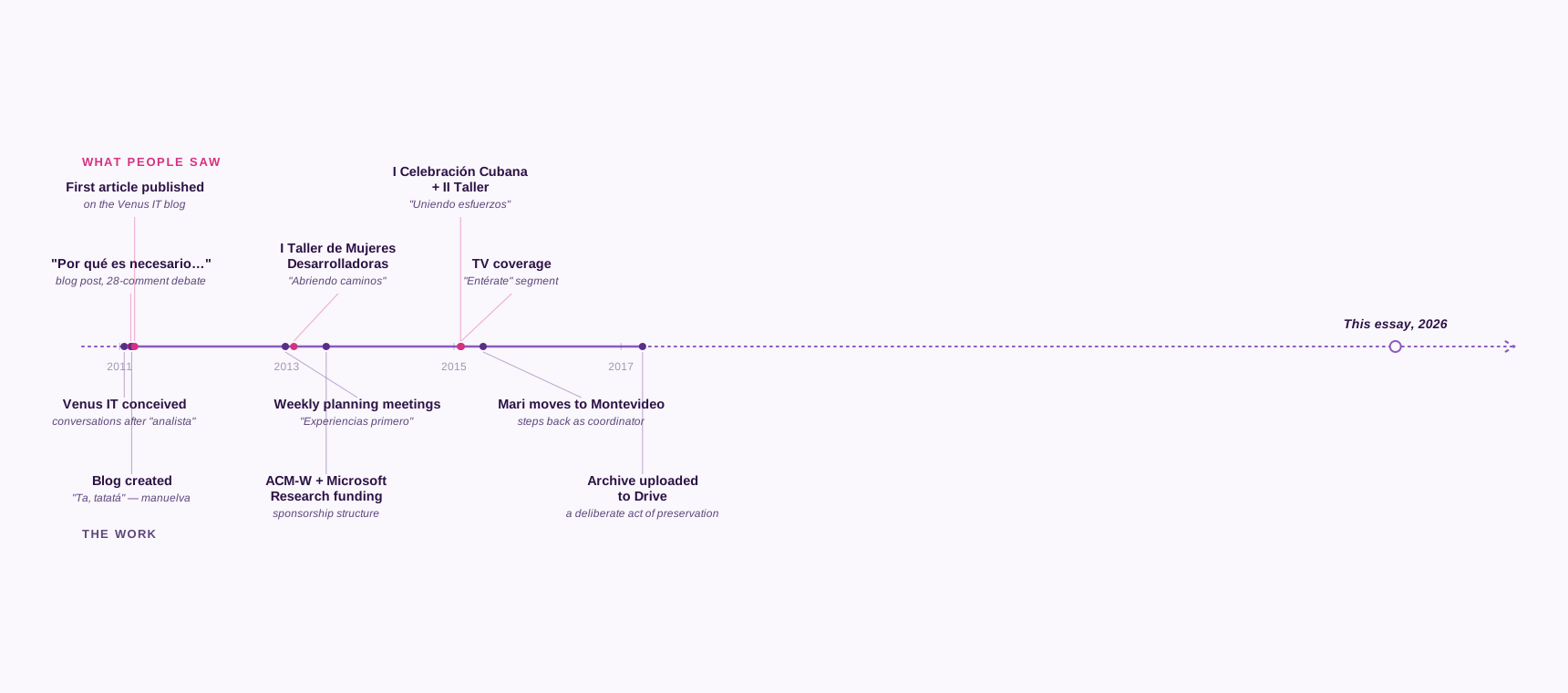
In April 2011 I published a post on a friend’s blog: “Why do the women developers of UCI need their own space?” I wrote about the women who had been foundational and integral to computing: Ada Lovelace, Grace Hopper, the six women of the ENIAC; and about organizations like Debian Women, Ubuntu Women and KDE Women. I made the case that students were being constrained in their learning and participation.
One programmer told me she never asked questions in the university’s technical blogs, because the boys might think her question is stupid (and tell her so). A male blogger replied, sincerely, that no one would ever think that. Both of them were telling the truth.
Twenty-eight comments followed, and reading them fifteen years later is like watching a community be born in a time-lapse. Women appeared out of nowhere to say I want to write code too! — “simplemente me dijeron: ¡Tú eres analista!” wrote one, who had been a developer until a reorganization quietly made her an analyst; another simply wrote “¡NO ES JUSTO!!!”
One woman added herself in the only language that felt safe: programmers_girls += yolanda;. She became one of the community founders and a dear friend to this day. Men joined the conversation too. Most were supportive, some were skeptical in a way that would become familiar: a separate space sounds isolating, “suena un poco aislado,” women were already welcome in the existing technical blogs and could participate whenever they wanted.
They were not hostile. They just couldn’t see that “welcome whenever you want” and “represented” are different states of a system. Four days after the post, Manuel (who managed the university’s blog hosting) created the blog and dropped the URL in the comments: “Ta, tatatá.” he announced with ceremony. There was now a place.
The committee of ideas
Around that time I wrote a short piece called How to kill an idea — “Cómo matar una idea.” You see, I argued, ideas remember how they are perceived, kill one today and another tomorrow: “we tried that already,” “that never works,” or worst of all, no response, and eventually the person in front of you stops bringing you ideas, because they don’t see a purpose on having or voicing them anymore. Eventually they stop having them at all; as if the ideas stop presenting themselves to the conscious mind, because the mind has learned they have nowhere to go. That’s the last stage, and the one I was actually afraid of: not a place where ideas get rejected, but a place where people no longer bother to have them.
Venus IT was our answer to that. We wanted to create a space where ideas had destination and purpose, where the default response was when do we start? “¿cuándo empezamos?”
The work nobody sees
I kept an archive of the community. Looking through it now, most of the files are about the small details.
"Asegurar local y datashow con su decana" - Secure venue with the dean;
"Garantizar las impresiones." - Handle printing;
"Contactar con el muchacho de la FEU para gestionar las 'cosas'" - Contact the student council for 'things';
In Cuba in 2013, las cosas could mean anything from chairs to snacks to the ineffable substance that makes an event officially exist.
We ran a contest asking “¿Quién fue la primera mujer desarrolladora cubana?” Who was the first woman programmer in Cuba? One of my recurring action items was to keep researching the answer, because no one seemed to have recorded it. We were trying to give women local role models while simultaneously discovering that the historical record had not been preserved. To me, that made the community even more necessary.
The planning document for our first meetup opens with four words I would still use as a principle for the community: “Experiencias primero.” Experiences first. People do not join communities for content. They join for the experience of being seen doing what they love with peers that share that love and enthusiasm for the same things.
They also join where the door is light: when the room is not an automatic exposition to judgement or shame. When we recruited speakers for the first meetup, the pitch I wrote was very intentionally unintimidating: presenting will help you practice, it will help other women, it can even be fun if you decide it is — “¡no hay presión ninguna!” No pressure!
We were asking women to do the exact thing they had been avoiding: stand in public and speak about their technical work — so we removed every ounce of stakes we could besides the technical. More people joined because less of the performance was demanded of them. The focus was the technical contributions.
The community archive also contains meeting notes. We kept them when there were only six or seven of us. Formal acuerdos, named owners, follow-ups — for a group that could have fit around one table and could have coordinated everything in hallway conversations.
It might look excessive now, but it was the way we assigned purpose to the work. A community becomes real the moment it starts taking itself seriously at a size where nobody else would take it seriously. By the time ACM-W and Microsoft Research were reading our paperwork in 2015, we had been producing paperwork for two years. The institutions didn’t make the community real. They recognized a legitimacy we had already practiced on the small.
On March 26, 2013, the blog’s second anniversary, we held the first Taller de Mujeres Desarrolladoras under the slogan Abriendo caminos — Forging new paths. We spent a full day in one of the university’s main theaters with keynotes by women professors, student presentations on Android development, RSS readers, social-network analysis.
The radical act was not the panel on gender; it was a woman standing onstage presenting the RSS reader she had built like it was the most natural thing in the world.
Normalizing what got you excluded is one of the core results of the work of equality.
Joining forces
Two years later we did something I still find slightly unbelievable: we connected a student community on a Cuban intranet into the international infrastructure of computing.
In March 2015, Venus IT organized the first Celebración Cubana de la Mujer en la Computación — Celebration of Women in Computing in Cuba, in partnership with ACM-W and Microsoft Research, the same structure that funded regional Celebrations of Women in Computing across North America.
Over two days the program included sixteen technical presentations, bilingual materials, a screening of Chimamanda Adichie’s “The Danger of a Single Story,” and local television coverage. The slogan had changed, and the change captured how the community had grown. In 2013 it was Abriendo caminos — Making a way. In 2015 it was Uniendo esfuerzos — joining forces. We had paved a way and now it was about extending that path into the international community.
The call for participation said something I’m still proud of: “Pueden participar estudiantes, profesores y especialistas de cualquier género.” Everyone is welcome. We had built a community that did not need to define itself by excluding in the other direction. The founding blog post had said it plainly in 2011: software is a technical process with a high degree of social component. We build better when we accept the input of the different perspectives of men and women. Many of our most reliable collaborators were men, beginning with Manuel, who had created the blog in the middle of the original comment thread.
The part I couldn’t take with me
In 2015 I left Cuba for Montevideo, Uruguay. Because of the way Cuba’s institutions and infrastructure worked, leaving the country also meant leaving the coordination of Venus IT.
The community lived on the university’s intranet and depended on institutional affiliations I could no longer access from outside the country. There was no mechanism through which Venus IT could continue to belong to its founders once one of us crossed the border, or through which I could remain part of its daily work from elsewhere. There was no succession design on our side either.
For a long time I understood this as a story about Cuba, and it is one. But I have built enough systems since then to recognize it as much a story about architecture and ecosystems. Venus IT’s legitimacy ran through institutions (the university, its intranet, eventually ACM-W); its energy ran through people; and nothing connected the two strongly enough to survive the departure of its founders.
I had correctly identified a need, gathered people around it, and built something real. I had yet to learn that what you build also depends on what is built on, and who can carry it forward. Our departure simply exposed the rigidity of the ecosystem, forcing us to confront the dependency of the infrastructure beneath Venus IT and our lack of ownership over it.
What remained
Venus IT was the first thing I ever built that was bigger than an assignment. It was where I learned that I could look at a broken system, refuse the explanation everyone accepted for it, gather people and help create an alternative.
I also learned about the beauty of community, of working together towards a shared purpose. Venus IT was real because of the people who proposed ideas, organized meetings, invited speakers, secured rooms, handled printing, presented their projects, created the blog, and decided that the work deserved to be taken seriously.
In 2017, I uploaded the Venus IT archive to Google Drive. Preserving it felt important. Years earlier, we had searched unsuccessfully for the name of Cuba’s first woman programmer because no one had kept the record. I did not want the work of this community — or the women who built it — to disappear in the same way.
One of the main things this experience taught me about building was that circumstances did not have the final say in what was possible. In my twenties, on an island, on an intranet, with six friends and a borrowed projector, I got to help forge a new path.